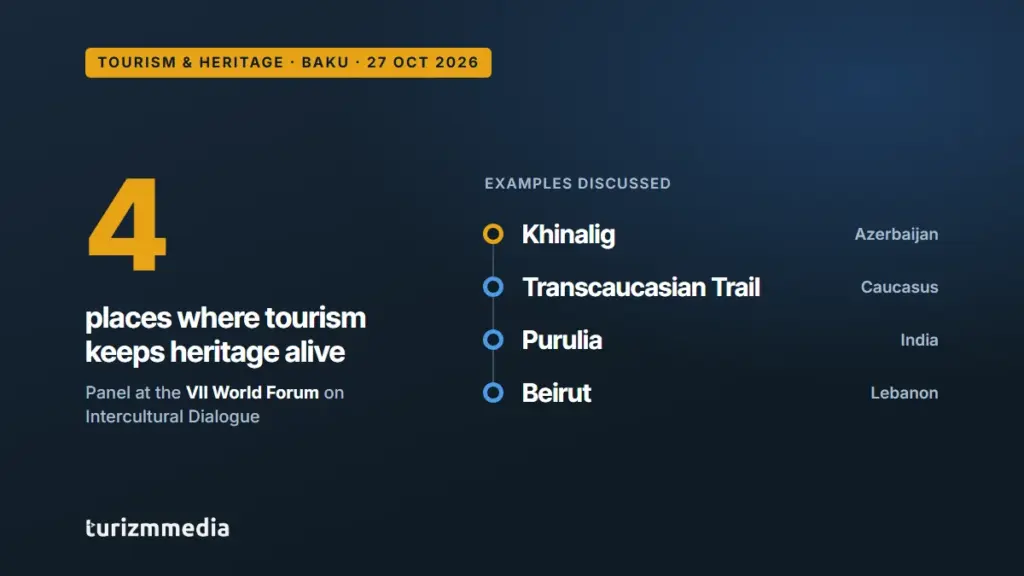
Can tourism help a remote mountain village keep its language, or give a post-war city a way to remember its past? A panel at the VII World Forum on Intercultural Dialogue in Baku on 27 October looked at examples from Azerbaijan, the wider South Caucasus, India and Lebanon.
Khinalig: heritage that people live in
Leyla Musayeva, head of the Cultural Heritage Development Department at Azerbaijan’s State Tourism Agency, said tourism helps preserve Khinalig’s cultural heritage, architecture, traditions and language. The high-mountain village in the Guba district and its cultural landscape were added to the UNESCO World Heritage List in 2023.
For visitors, this is what makes Khinalig special: it is not a museum, but a living community with its own language and way of life. Responsible visits can bring income to local families and give them a reason to stay.
A trail from the Caspian to the Black Sea
Gunay Moshad, programme director of the Transcaucasian Trail Association, said that developing tourism routes in the South Caucasus creates opportunities for young people and women and strengthens ties between local communities. The Transcaucasian Trail project aims to create a long-distance hiking route linking the Caspian and Black Seas.
Lessons from India and Lebanon
Madhura Dutta of Contact Base explained how cultural tourism helped turn the Purulia district in India into a popular destination. Through the “Art for Life” programme, local people have found work in traditional crafts, and more than 10,000 creative professionals, many of them women, now work in the district.
The founder of Layers of Lebanon described tours along Beirut’s former Green Line, which use archives, photographs and witness accounts to preserve the memory of the civil war.
An expert on indigenous tourism added that indigenous peoples should define their own approach to tourism on their ancestral lands, and that projects should be developed together with local communities.
Why it matters for Azerbaijan
Azerbaijan’s 2026–2030 tourism programme puts a strong focus on the regions, hiking trails and cultural tourism. The discussion in Baku showed a common lesson: heritage tourism works best when local people are partners, not just hosts.