On 20 August 2026, President Ilham Aliyev approved the State Programme for the Development of Tourism in Azerbaijan for 2026–2030. It sets targets for the next five years and lists the tools the government plans to use. Here are the main points.
The targets
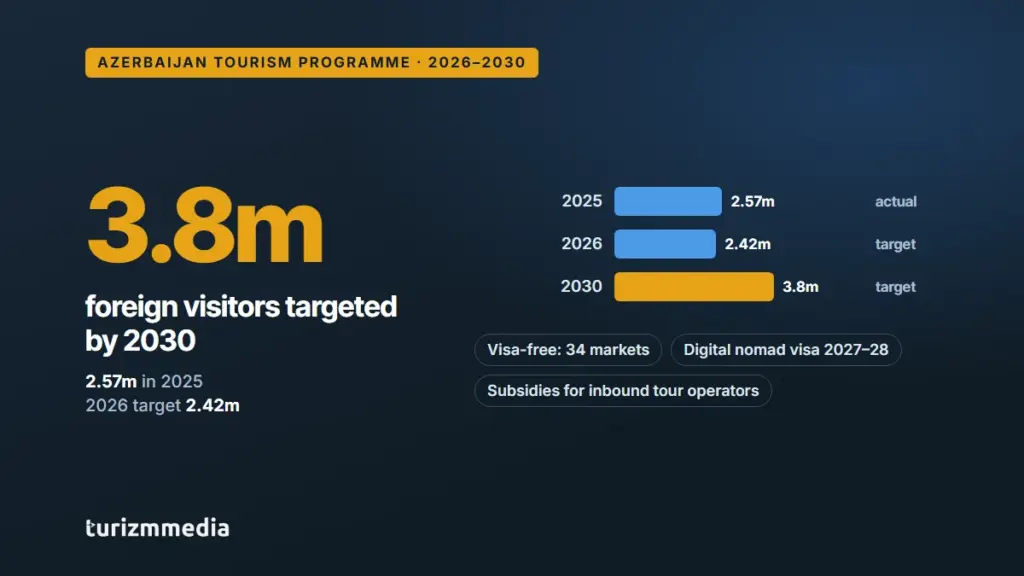
- Foreign visitors: from 2.57 million in 2025 to 3.8 million in 2030. The target for 2026 is 2.42 million.
- Value added by tourism-related sectors: from 6.96 billion manat in 2025 to 8.51 billion in 2027 and 12.17 billion in 2030, or roughly 40% real growth.
The programme starts in a difficult year. In the first half of 2026, foreign arrivals fell 10.3% to 1.09 million, and visitors from the Gulf countries dropped 31.4%. For January–August, the total was 1.585 million, 8% below last year.
Easier entry
The programme plans to extend visa-free travel to 34 target markets, widen electronic visa options and introduce a digital nomad visa in 2027–2028 for remote workers who want to stay longer.
Support for business and flights
Subsidies are planned for local tour operators that bring foreign tourists to Azerbaijan and for micro and small tourism businesses. The state also plans to cover part of the cost of charter flights, encourage new regular routes from priority countries and support concerts and other events.
The details are still being worked out. The Cabinet of Ministers had three months to propose the rules for subsidies and investment incentive certificates for tourism projects, which puts the next milestone around 20 November 2026. The Ministry of Digital Development and Transport had the same deadline for proposals on aviation. Changes to the Law on Tourism are due within six months.
Beyond Baku
A key aim is to spread tourism to the regions through tourism zones, hiking trails, and health and food tourism. In the territories under reconstruction, such as Lachin and Kalbajar, qualifying businesses already receive a ten-year exemption from profit or income tax, property tax, land tax and simplified tax, which has applied since 1 January 2023.
Progress will be reported to the President once a year. Monitoring has been assigned to the Centre for Analysis of Economic Reforms and Communication.